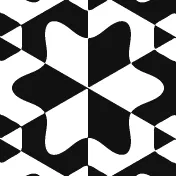
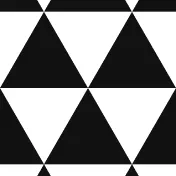
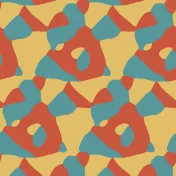
Generated by just two symmetries instead of three triangle mirrors: a one-sixth turn α about a 6-centre and the mirror R halfway to the next 6-centre. Because R² = 1 and P = αRα⁻¹RαR has P² = 1, any clockwork time shift must satisfy 2τ(α) ≡ 0 and 2τ(R) ≡ 0 (mod 1), giving a clean 2 × 2 grid of the 4 polar space groups (P6mm, P6cc, P6₃cm, P6₃mc).
∗632
∗632
order1/6 rotationreflection
Plate overlay:
Showing the minimal 2 generators: α (one-sixth turn at the right 6-centre) and R (vertical mirror halfway to the left 6-centre).
Opens the public Sketchfab WebGL viewer externally. Only one crystal viewer stays live at a time.
Plain 1-colouring: both generators fix the single colour (τ(α) = 0, τ(R) = 0), so every reconstructed mirror Q = Rα⁻¹RαR and P = αRα⁻¹RαR also has τ = 0.
How α and R generate the 3 triangle mirrors (P, Q, R) and lattice
Element
Word in α, R
Geometry
Induced time shift τ
R
R
vertical mirror at x = −1/2
none (m-mirror)
Q
R α⁻¹ R α R
diagonal mirror through 6-centre
none (m-mirror)
P
α R α⁻¹ R α R
horizontal mirror through 6-centre
none (m-mirror)
t₁
(α R)²
primitive lattice translation (1, 0)
0 (colour-fixing)
t₂
(α⁻¹ R)²
primitive lattice translation (0, 1)
0 (colour-fixing)
Identifications
Book type auditThe book crop supporting the displayed short form. For a composite cyclic extension with no literal book row, this uses the nearest available rule or type audit and marks that limitation.The Symmetries of Things · p. 40
Other names(∗·6·3·2)Conway fibrifold notationConway's decorated orbifold name for this lift. It records the horizontal base orbifold and the fractional height translations coupled to its generators; this page uses the alias for the chosen height direction.P6mmHermann–Mauguin space-group symbolThe short international Hermann–Mauguin symbol for this three-dimensional space-group type. Full form: P 6 m m.No. 183International Tables numberThe standard International Tables number identifying this three-dimensional space-group type.C6v1Schoenflies space-group symbolThe Schoenflies symbol for the full three-dimensional space-group type; its superscript distinguishes types with the same point group.P 6 -2Hall setting symbolThe Hall symbol for the selected coordinate setting; unlike a bare Hermann–Mauguin type symbol, it fixes the setting unambiguously.g268Catalog instanceThe matching animated example in the forward-time catalog; gN is this project's record identifier.
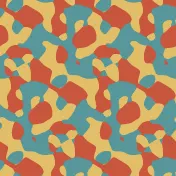
The 1/6-turn α fixes colours (τ(α) = 0), while the mirror R swaps blue ↔ orange (τ(R) = 1/2). Because Q = Rα⁻¹RαR and P = αRα⁻¹RαR each use R three times, all three triangle mirrors get τ = 3/2 ≡ 1/2 (c-glides).
How α and R generate the 3 triangle mirrors (P, Q, R) and lattice
Element
Word in α, R
Geometry
Induced time shift τ
R
R
vertical mirror at x = −1/2
+1/2 period (c-glide)
Q
R α⁻¹ R α R
diagonal mirror through 6-centre
+1/2 period (c-glide)
P
α R α⁻¹ R α R
horizontal mirror through 6-centre
+1/2 period (c-glide)
t₁
(α R)²
primitive lattice translation (1, 0)
0 (colour-fixing)
t₂
(α⁻¹ R)²
primitive lattice translation (0, 1)
0 (colour-fixing)
Identifications
Book type auditThe book crop supporting the displayed short form. For a composite cyclic extension with no literal book row, this uses the nearest available rule or type audit and marks that limitation.The Symmetries of Things · p. 140
Other names(∗:6:3:2)Conway fibrifold notationConway's decorated orbifold name for this lift. It records the horizontal base orbifold and the fractional height translations coupled to its generators; this page uses the alias for the chosen height direction.P6ccHermann–Mauguin space-group symbolThe short international Hermann–Mauguin symbol for this three-dimensional space-group type. Full form: P 6 c c.No. 184International Tables numberThe standard International Tables number identifying this three-dimensional space-group type.C6v2Schoenflies space-group symbolThe Schoenflies symbol for the full three-dimensional space-group type; its superscript distinguishes types with the same point group.P 6 -2cHall setting symbolThe Hall symbol for the selected coordinate setting; unlike a bare Hermann–Mauguin type symbol, it fixes the setting unambiguously.g270Catalog instanceThe matching animated example in the forward-time catalog; gN is this project's record identifier.
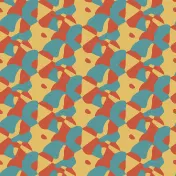
Both generators swap blue ↔ orange (τ(α) = 1/2, τ(R) = 1/2). Then Q = Rα⁻¹RαR gets τ(Q) = 3(1/2) ≡ 1/2 (c-glide), while P = αQ cancels the two half-period shifts: τ(P) = 1/2 + 1/2 ≡ 0 (plain mirror m).
How α and R generate the 3 triangle mirrors (P, Q, R) and lattice
Element
Word in α, R
Geometry
Induced time shift τ
R
R
vertical mirror at x = −1/2
+1/2 period (c-glide)
Q
R α⁻¹ R α R
diagonal mirror through 6-centre
+1/2 period (c-glide)
P
α R α⁻¹ R α R
horizontal mirror through 6-centre
none (m-mirror)
t₁
(α R)²
primitive lattice translation (1, 0)
0 (colour-fixing)
t₂
(α⁻¹ R)²
primitive lattice translation (0, 1)
0 (colour-fixing)
Identifications
Book type auditThe book crop supporting the displayed short form. For a composite cyclic extension with no literal book row, this uses the nearest available rule or type audit and marks that limitation.The Symmetries of Things · p. 140
Other names(∗·6:3:2)Conway fibrifold notationConway's decorated orbifold name for this lift. It records the horizontal base orbifold and the fractional height translations coupled to its generators; this page uses the alias for the chosen height direction.P63cmHermann–Mauguin space-group symbolThe short international Hermann–Mauguin symbol for this three-dimensional space-group type. Full form: P 6_3 c m.No. 185International Tables numberThe standard International Tables number identifying this three-dimensional space-group type.C6v3Schoenflies space-group symbolThe Schoenflies symbol for the full three-dimensional space-group type; its superscript distinguishes types with the same point group.P 6c -2Hall setting symbolThe Hall symbol for the selected coordinate setting; unlike a bare Hermann–Mauguin type symbol, it fixes the setting unambiguously.g269Catalog instanceThe matching animated example in the forward-time catalog; gN is this project's record identifier.
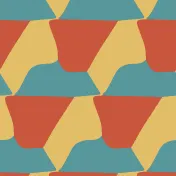
The 1/6-turn α swaps blue ↔ orange (τ(α) = 1/2, a 6₃ screw), while the mirror R fixes colours (τ(R) = 0). Thus Q = Rα⁻¹RαR stays a plain mirror (τ(Q) = 0), whereas P = αQ inherits τ(P) = 1/2 (c-glide).
How α and R generate the 3 triangle mirrors (P, Q, R) and lattice
Element
Word in α, R
Geometry
Induced time shift τ
R
R
vertical mirror at x = −1/2
none (m-mirror)
Q
R α⁻¹ R α R
diagonal mirror through 6-centre
none (m-mirror)
P
α R α⁻¹ R α R
horizontal mirror through 6-centre
+1/2 period (c-glide)
t₁
(α R)²
primitive lattice translation (1, 0)
0 (colour-fixing)
t₂
(α⁻¹ R)²
primitive lattice translation (0, 1)
0 (colour-fixing)
Identifications
Book type auditThe book crop supporting the displayed short form. For a composite cyclic extension with no literal book row, this uses the nearest available rule or type audit and marks that limitation.The Symmetries of Things · p. 140
Other names(∗:6·3·2)Conway fibrifold notationConway's decorated orbifold name for this lift. It records the horizontal base orbifold and the fractional height translations coupled to its generators; this page uses the alias for the chosen height direction.P63mcHermann–Mauguin space-group symbolThe short international Hermann–Mauguin symbol for this three-dimensional space-group type. Full form: P 6_3 m c.No. 186International Tables numberThe standard International Tables number identifying this three-dimensional space-group type.C6v4Schoenflies space-group symbolThe Schoenflies symbol for the full three-dimensional space-group type; its superscript distinguishes types with the same point group.P 6c -2cHall setting symbolThe Hall symbol for the selected coordinate setting; unlike a bare Hermann–Mauguin type symbol, it fixes the setting unambiguously.g271Catalog instanceThe matching animated example in the forward-time catalog; gN is this project's record identifier.
Minimal generating set · 2 generators instead of 3
Why ∗632 (p6m) needs only α and R
In the standard Coxeter presentation ⟨P, Q, R | P² = Q² = R² = (PQ)⁶ = (QR)³ = (RP)² = 1⟩, the wallpaper group ∗632 (p6m) is generated by the three mirror sides of a (6, 3, 2) triangle. Yet as shown in Wallpaper groups by their fewest generators ↗, ∗632 can be generated by just two elements (whereas its index-2 subgroup ∗333 / p3m1 and ∗442 / p4m each require 3):
α = PQ: a counterclockwise one-sixth turn about the 6-fold centre at the right rosette; and
R: the vertical mirror reflection halfway to the neighbouring 6-fold centre at the left rosette.
Conjugating R by powers of α surrounds the 6-centre with a regular hexagon of mirrors. Two adjacent sides of that hexagon, R and α⁻¹Rα, meet at 60° at a 3-fold corner, so their product has order 3: (αRα⁻¹R)³ = 1. Reflecting α⁻¹Rα across R folds the mirror across that 60° corner into the diagonal mirror Q = Rα⁻¹RαR passing straight through the 6-centre. Rotating Q by α then gives the horizontal mirror P = αQ = αRα⁻¹RαR, and the squares of the glide words t₁ = (αR)² and t₂ = (α⁻¹R)² span the entire hexagonal translation lattice.
All 4 forward clockwork lifts from (τ(α), τ(R)) ∈ {0, ½}²
In the 2-generator presentation Γ = ⟨α, R | α⁶ = R² = (αRα⁻¹R)³ = (αRα⁻¹RαR)² = 1⟩, a forward time-shift homomorphism τ : Γ → ℝ/ℤ is determined by τ(α) and τ(R):
Projected along the clock axis, these are the actual symbols used on the static 2D diagrams. Open arrows mark primitive translations in the picture; the crystallographic filled core shows the 2-, 3-, 4-, or 6-fold spatial order. For a forward skip τ, the screw subscript is m ≡ nτ (mod n) for a positive 1/n-turn and m ≡ −nτ (mod n) for the opposite turn, with 0 ≤ m < n. Screw tails prolong the polygon edges, as in the Tables; a mirrored pinwheel records the opposite spatial turn sense, not backward time.
Translations in the projection plane
Primitive translationOpen arrow; its direction is the named in-plane translation X, Y, or α.
Rotation and screw axes (along the clock axis)
2-fold rotation axisFilled lens; half-turn with no clock-axis rise.
21 screw axisTwo-arm lens; half-turn with a +1/2-period rise.
3-fold rotation axisFilled triangle; one-third turn with no clock-axis rise.
31 screw axisThree-stroke triangle; positive one-third turn with a +1/3-period rise.
32 screw axisOpposite three-stroke triangle; positive one-third turn with a +2/3-period rise.
4-fold rotation axisFilled diamond; quarter-turn with no clock-axis rise.
41 screw axisFour-arm diamond; positive quarter-turn with a +1/4-period rise.
42 screw axisTwo-arm diamond; quarter-turn with a +1/2-period rise.
43 screw axisOpposite four-arm diamond; positive quarter-turn with a +3/4-period rise.
6-fold rotation axisFilled hexagon; one-sixth turn with no clock-axis rise.
61 screw axisSix-arm hexagon; positive one-sixth turn with a +1/6-period rise.
62 screw axisThree-arm hexagon; positive one-sixth turn with a +1/3-period rise.
63 screw axisTwo-arm hexagon; one-sixth turn with a +1/2-period rise.
64 screw axisOpposite three-arm hexagon; positive one-sixth turn with a +2/3-period rise.
65 screw axisOpposite six-arm hexagon; positive one-sixth turn with a +5/6-period rise.
Mirror and glide planes (seen edge-on)
Mirror plane (m)Solid line; reflection with no glide component.
In-plane axial glideDashed line with a half arrow; reflection plus a half-cell step, the arrow giving the direction of that step.
Clock-axis glide (c)Dotted line; reflection plus a half-period step perpendicular to the picture.
Diagonal n-glideDash–dot line; half-steps in the picture and along the clock axis.
Quarter-diagonal d-glideArrowed dash–dot line; arrows select the sign of the quarter-period component.
The burgundy α, β, γ, … or P, Q, … beside a diagram symbol identifies its Generator row. The Color and Time columns state the same forward clock action directly.